Exterior Shading Solutions for Los Angeles Home Renovations
Exterior Shading Solutions for Los Angeles Home Renovations
Reading time: 12 minutes
Los Angeles homeowners know the struggle all too well: gorgeous sunshine 300+ days a year sounds like paradise — until your living room hits 95°F by noon, your energy bills spike past $400 a month, and your hardwood floors start fading from UV exposure. Sound familiar? You’re definitely not alone.
In 2026, exterior shading has evolved from a simple aesthetic upgrade into one of the smartest investments an LA homeowner can make. Between California’s aggressive energy efficiency mandates, the escalating heat island effect in urban neighborhoods, and rapidly advancing shading technologies, the landscape has shifted dramatically. Whether you’re renovating a mid-century modern in Silver Lake, a Spanish Colonial in Hancock Park, or a contemporary build in the Pacific Palisades, the right exterior shading solution can cut cooling costs by 30–50%, dramatically improve indoor comfort, and seriously boost your home’s curb appeal.
This guide cuts through the noise and gives you the straight talk on what works, what doesn’t, and how to approach your renovation with strategic precision.
Table of Contents
- Why Exterior Shading Matters More Than Ever in LA
- The Main Types of Exterior Shading Solutions
- Comparing Your Options: Performance, Cost, and Aesthetics
- Real LA Renovations: What Actually Worked
- Common Challenges and How to Overcome Them
- LA Building Codes and HOA Considerations in 2026
- Energy Savings by Shading Type
- Frequently Asked Questions
- Your Shading Renovation Roadmap
Why Exterior Shading Matters More Than Ever in LA
Let’s set the scene with some sobering numbers. According to the California Energy Commission’s 2025 Residential Energy Report, residential cooling accounts for nearly 23% of total household energy consumption in Southern California — a figure that has risen 18% over the past decade due to increasing average temperatures and urban densification. The LA basin recorded its third consecutive year of record-breaking summer temperatures in 2025, with several neighborhoods in the San Fernando Valley and Inland Empire logging triple-digit days well into October.
But here’s what’s really interesting: exterior shading is dramatically more effective than interior solutions. When sunlight passes through glass into your home, it converts to heat energy that your air conditioner then has to fight against. Blocking that solar radiation before it enters is up to 7 times more efficient than trying to cool the air after the heat is already inside. This fundamental physics principle is why savvy LA renovators are increasingly prioritizing the exterior envelope of their homes over interior upgrades like blackout curtains or solar films.
“In our climate modeling work across Southern California, we consistently find that strategic exterior shading is the single highest-ROI passive cooling intervention available to homeowners. The right overhang or shade structure can reduce peak cooling loads by 40% or more.” — Dr. Melissa Tran, Building Performance Institute, 2025 Pacific Coast Sustainability Symposium
The financial calculus is compelling too. With Southern California Edison’s tiered electricity rates averaging $0.38–0.52 per kWh during peak summer hours in 2026, reducing your cooling load isn’t just comfortable — it’s financially smart. Add in California’s Title 24 energy efficiency requirements that now apply to many renovation projects, and exterior shading has moved from a luxury consideration to a strategic necessity.
The Main Types of Exterior Shading Solutions
Fixed Architectural Shading: The Permanent Performers
Fixed architectural shading solutions are integrated directly into the home’s structure and represent the highest-performance, longest-lasting option for most LA renovations. These include:
- Roof Overhangs and Extended Eaves: Properly engineered overhangs are among the most effective shading strategies available. For south-facing windows in Los Angeles (latitude ~34°N), an overhang depth equal to roughly 50–60% of the window height can block virtually all direct summer sun while still allowing low-angle winter sun to passively heat your home. This seasonal balance is elegant in its simplicity.
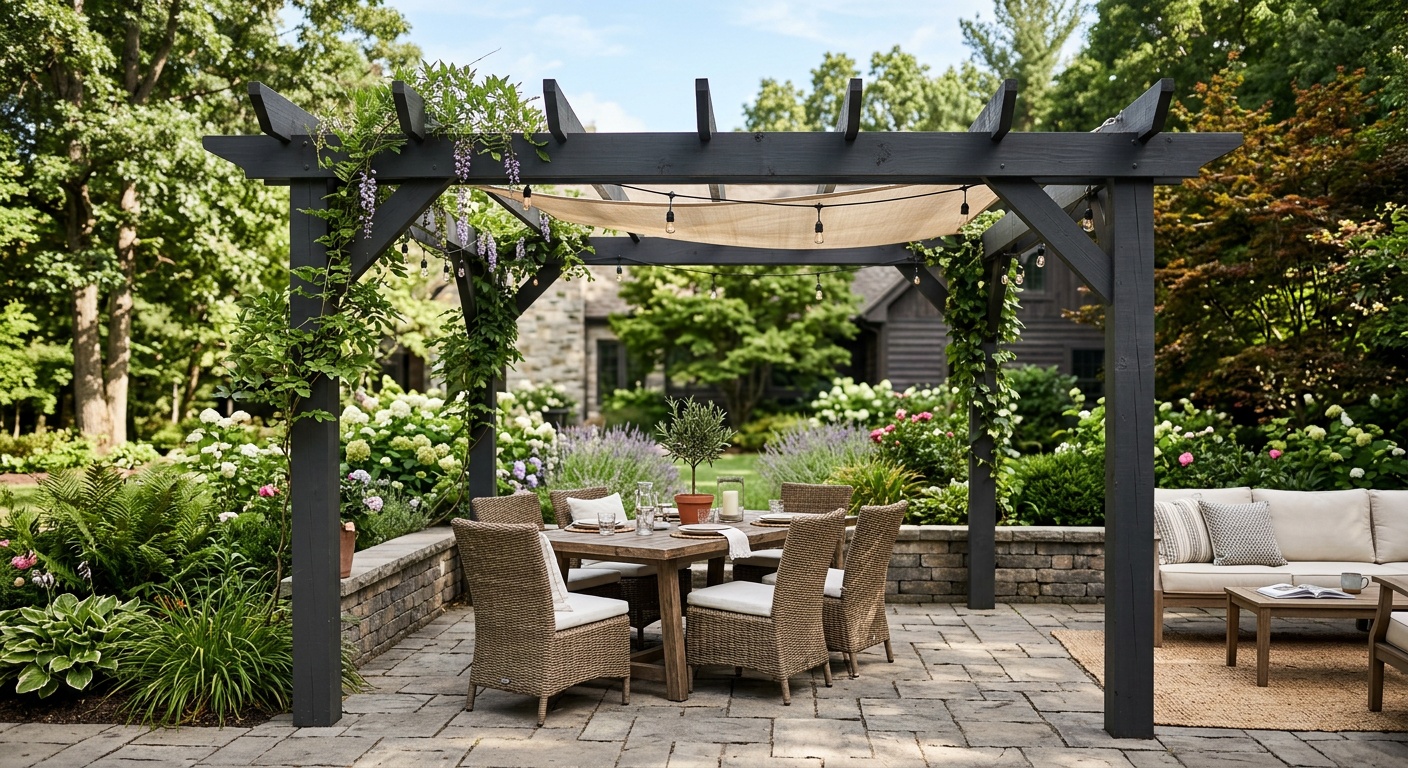
- Pergolas and Shade Structures: Freestanding or attached pergolas have surged in popularity across LA’s outdoor living spaces. Modern pergolas with louvered aluminum slats — which can be motorized — offer the flexibility of a fixed structure with adjustable light control.
- Brise-Soleil Panels: Borrowed from mid-century modernist architecture (you’ll see stunning examples on original homes in Brentwood and West Hollywood), horizontal or vertical fin systems create dramatic shade while preserving views and natural ventilation.
- Cantilevered Shade Decks: For multi-story homes, extended upper-floor decks or balconies serve as built-in shading devices for lower-floor windows — a structural solution that does double duty.
Retractable and Flexible Shading Systems
The retractable shading market has exploded in sophistication. In 2026, motorized systems with smart-home integration are accessible at price points that would have seemed exclusive just five years ago. Key categories include:
- Motorized Retractable Awnings: Modern cassette awnings from brands like Somfy, Sunesta, and Weinor can extend up to 18 feet with wind-sensor automation that retracts them before gusts cause damage. Many integrate with Google Home, Apple HomeKit, and Amazon Alexa ecosystems, adjusting automatically based on sun position and temperature data.
- Exterior Solar Screens and Roll Shades: These are often the highest-value-per-dollar option for east and west-facing windows. Exterior solar screen fabrics — typically in 3%, 5%, or 10% openness factors — block 70–95% of solar radiation while maintaining outward views. Unlike interior blinds, they stop heat at the glass surface.
- Shade Sails: A perennially popular LA choice, tensioned shade sails create dramatic outdoor rooms and can shade large patio areas economically. High-performance fabrics like Coolaroo’s 96% UV-block material have dramatically improved durability in recent years.
- Vertical Exterior Screens: ZIP system exterior screens that roll down into the facade are gaining traction in high-end renovations, providing full-facade solar control on west-facing walls that would otherwise bake in afternoon sun.
Living and Green Shading Solutions
For homeowners committed to sustainability and biophilic design, living shading solutions offer a compelling combination of environmental benefits, aesthetics, and performance:
- Green Walls and Vertical Gardens: Modular green wall systems on south and west facades can reduce wall surface temperatures by 15–30°F through evapotranspiration cooling. They require irrigation systems and ongoing maintenance, but the visual impact is stunning.
- Strategic Tree Planting: A mature deciduous tree placed optimally on the southwest corner of an LA home can reduce cooling costs by $100–200 annually. Trees like Jacaranda, Chinese Pistache, and California Sycamore are climate-appropriate choices that offer seasonal shade and drop their leaves in winter to allow solar gain.
- Trellis with Climbing Plants: Wisteria, bougainvillea, and passion fruit on well-engineered trellises create beautiful, functional shade screens. The upfront investment is modest, though establishment takes 2–4 growing seasons.
Comparing Your Options: Performance, Cost, and Aesthetics
| Shading Solution | Avg. Cost (Installed) | Solar Reduction | Lifespan | Maintenance Level |
|---|---|---|---|---|
| Extended Roof Overhang | $3,500–$12,000 | Up to 80% | 40+ years | Very Low |
| Motorized Retractable Awning | $2,800–$9,000 | 60–75% | 15–25 years | Low–Medium |
| Exterior Solar Screens | $600–$2,200/window | 70–95% | 10–20 years | Low |
| Louvered Pergola (Motorized) | $15,000–$45,000 | Variable (0–100%) | 25–35 years | Low–Medium |
| Strategic Deciduous Trees | $800–$3,500 planted | 40–60% (mature) | 50–100+ years | Medium |
Real LA Renovations: What Actually Worked
Case Study 1: The Culver City Bungalow Transformation
In early 2025, a couple renovating their 1940s Culver City bungalow faced a classic LA dilemma: a row of west-facing single-pane windows that turned their living room into an oven every afternoon. Their contractor proposed window replacement at a cost of $18,000. Instead, after consulting with a building performance specialist, they invested $4,200 in a combination of exterior solar screens (10% openness factor, in a charcoal color that complemented their home’s exterior) and a simple trellis system with fast-growing Stephanotis vines.
The results after one full summer season were striking: their afternoon cooling set point dropped from 76°F to 72°F while their AC ran 40% less frequently. Their July 2025 SCE bill dropped from $387 to $231. Total payback period: estimated 3.2 years. The lesson? Sometimes the lowest-cost intervention delivers the highest ROI.
Case Study 2: The Highland Park Modern Renovation
A more ambitious project in Highland Park involved a complete exterior transformation of a 2,400 sq ft contemporary home. The design-forward owners worked with a local architect to incorporate a full brise-soleil system of powder-coated aluminum horizontal fins on the south and west facades. The total installation cost was $28,500, but the system became a signature architectural feature visible from the street — ultimately contributing to a home appraisal increase of approximately $45,000 when comparable homes in the neighborhood sold in late 2025.
The brise-soleil reduced direct solar gain by approximately 65% on the primary living areas, cutting annual cooling costs by an estimated $1,800. But for this household, the aesthetic and property value dimensions were equally compelling as the energy savings. The takeaway: exterior shading can be simultaneously functional infrastructure and architectural identity.
Case Study 3: The Valley Village Smart Shade System
A technology-enthusiastic homeowner in Valley Village — a neighborhood that regularly posts among LA’s hottest summer temperatures — took an integrated approach in their 2026 renovation. They installed motorized cassette awnings on all south and west-facing windows, connected through a Somfy TaHoma smart hub to their existing Google Home ecosystem. Custom automation rules retract the awnings when wind speeds exceed 18 mph (monitored via a rooftop weather station) and extend them automatically when the forecast predicts temperatures above 82°F.
Energy monitoring showed a 44% reduction in peak summer cooling costs compared to their previous summer. More significantly, during the 2025 heat emergency events, their home maintained comfortable temperatures without triggering the emergency rate tier on their utility plan — saving them an additional estimated $180 in a single billing period.
Common Challenges and How to Overcome Them
Even with the best intentions, LA homeowners run into predictable obstacles. Here are the three most common — and how to navigate them:
Challenge 1: Wind Load Engineering for Permanent Structures
Los Angeles is not just hot — it’s windy, particularly during Santa Ana conditions. Extended overhangs, pergolas, and shade sails must be engineered to handle wind loads that can exceed 90 mph during major events. In 2026, LA County building departments require structural calculations for any shade structure exceeding 120 square feet or attached to the primary structure. The solution: always engage a licensed structural engineer for permanent installations, and ensure your contractor pulls the appropriate permits. Unpermitted shade structures that fail during Santa Ana winds create significant liability exposure.
Challenge 2: HOA Restrictions and Design Review
Roughly 40% of LA County residential properties are subject to HOA covenants, many of which have aesthetic restrictions that complicate exterior modifications. The strategic approach: request the HOA’s Architectural Review Committee guidelines before you design anything, and consider presenting your shading solution as an architectural enhancement rather than a functional addition. Including professional renderings in your submission dramatically increases approval rates. Several HOAs in communities like Playa Vista and Warner Center have also adopted pre-approved shading product lists in 2025–2026 that streamline the process considerably.
Challenge 3: Balancing Shading with Natural Light and Views
One of the most common complaints after shading installations is that homeowners feel their interiors have become too dark or that prized views are compromised. The solution lies in product selection and orientation strategy. Exterior solar screens with a 10% openness factor in a lighter color (like beige or grey) maintain outward visibility while blocking solar radiation. Working with a solar orientation consultant — or using free tools like the Sustainable By Design Overhang Analysis web tool — to model seasonal sun angles before installation prevents this mistake entirely.
LA Building Codes and HOA Considerations in 2026
California’s regulatory environment for home energy efficiency has tightened meaningfully. Here are the key frameworks affecting exterior shading decisions in 2026:
- Title 24 (2025 Update): California’s building energy efficiency standards, updated in the 2025 code cycle effective January 2026, now include prescriptive requirements for exterior shading on west-facing glazing in Climate Zone 9 (most of LA) for renovation projects exceeding $50,000 in permitted value. This means many medium-to-large renovations will need to include qualified exterior shading to pass compliance.
- LA County Grading and Building Permits: Any shade structure attached to the primary dwelling requires a building permit. Detached structures over 200 sq ft similarly require permits. Fines for unpermitted work in LA County were increased in 2025 to $1,500–$5,000 per violation.
- LADWP Solar Incentives: The Los Angeles Department of Water and Power continues to offer rebates through the Shade and Cool LA program (extended through 2027), providing rebates of $0.15–$0.35 per kWh of estimated annual savings for qualifying exterior shading installations. For a typical West-facing window shading project, this can translate to $200–$800 in direct rebates.
- Tree Canopy Protections: If your shading strategy involves mature tree removal (to create clearance for structures), be aware that LA’s Urban Forestry Division requires permits for removal of heritage trees and many large trees on residential properties.
Energy Savings by Shading Type: LA Climate Zone 9
The chart below represents estimated annual cooling energy reduction percentages for each primary shading solution type in Los Angeles Climate Zone 9, based on 2025 California Energy Commission modeling data.
Annual Cooling Energy Reduction (%) — LA Climate Zone 9
Source: California Energy Commission Climate Zone 9 Residential Modeling, 2025. Values represent peak west-facing window solar gain reduction under summer design conditions.
Frequently Asked Questions
Do exterior shading solutions require building permits in Los Angeles?
It depends on the type and scale of the installation. Freestanding shade sails and small retractable awnings under 120 square feet typically don’t require permits in most LA jurisdictions. However, any structure attached to your home’s primary framing — including extended overhangs, attached pergolas, and brise-soleil systems — generally requires a building permit and structural review. Permanent structures over 200 square feet, even freestanding, typically trigger permit requirements. Always check with your local LA County or City of Los Angeles Building and Safety office before commencing work, and remember that unpermitted structures can complicate future home sales and insurance claims.
What is the most cost-effective exterior shading upgrade for a typical LA home?
For most homeowners, exterior solar screens on west-facing windows deliver the best combination of performance, cost, and ease of installation. At $600–$1,500 per window installed, they can reduce solar heat gain through those windows by 70–95%, with payback periods often under four years at current LA utility rates. If outdoor living space is a priority, a well-placed shade sail covering a west-facing patio can be installed for $1,500–$4,000 and simultaneously shades both the outdoor space and any adjacent windows or sliding doors. Strategic tree planting offers the best long-term ROI but requires patience while trees mature to full shade capacity.
Can exterior shading qualify for California energy rebates or tax incentives in 2026?
Yes, several programs apply. The LADWP’s Shade and Cool LA rebate program (extended through 2027) provides direct rebates for qualifying exterior shading installations on homes within the LADWP service territory — typically $200–$800 depending on installation type and projected energy savings. Additionally, shade trees planted through approved programs may qualify for the LA County Urban Forestry rebate of $50–$150 per qualifying tree. For larger commercial-scale renovations, federal IRA (Inflation Reduction Act) provisions may apply if shading is part of a broader energy efficiency upgrade package. Always consult with your tax professional and check current LADWP and CEC program status, as rebate structures can change between program years.
Your Shading Renovation Roadmap: Shade Smarter, Live Better
The relationship between thoughtful exterior shading and Los Angeles living quality has never been more direct — or more financially compelling. As temperatures continue their upward trajectory and utility rates track alongside them, the homeowners who act strategically today are building genuinely resilient, comfortable, and valuable properties for tomorrow.
Here’s your practical action plan:
- Audit Your Exposure First (Week 1): Walk your property at 10 AM, 1 PM, and 4 PM on a clear summer day (or use a free sun-angle app like Sun Seeker). Identify which windows and outdoor spaces receive the most direct solar exposure. Note: west and southwest-facing surfaces are almost always your highest priority in LA’s climate.
- Set Your Budget Framework (Week 1–2): Decide whether you’re optimizing for lowest upfront cost (exterior solar screens, shade sails), highest long-term performance (architectural overhangs, brise-soleil), or maximum lifestyle enhancement (motorized louvered pergola, smart awning systems). These goals shape completely different solution paths.
- Check HOA and Permit Requirements Before Designing (Week 2): A 20-minute call to your HOA’s architectural review contact and a quick review of LADBS permit thresholds can save you weeks of redesign later. Get these constraints on the table before you fall in love with a specific product or design.
- Get 3 Installer Quotes with Energy Performance Data (Week 3–4): Ask every contractor for projected annual kWh savings, not just product specifications. Reputable installers will model this. Require that quotes include permit-pulling costs where applicable.
- Stack Your Incentives (Before Project Close-Out): Before your final contractor payment, ensure you’ve registered for applicable LADWP and any LA County rebates. Some programs require pre-installation enrollment, so research this in Week 2 alongside your permit check.
Key Takeaways Worth Carrying Forward:
- Exterior shading blocks heat before it enters your home — it’s fundamentally more efficient than any interior solution
- The best solution for your home depends on orientation, budget, aesthetics, and whether you prioritize flexibility or permanence
- In 2026’s regulatory environment, Title 24 compliance is increasingly relevant for renovation projects — treat shading as code strategy, not just comfort
- Layering approaches (e.g., exterior screens plus strategic trees) typically outperforms any single solution
- Property value impact is real and documented — done right, exterior shading is architecture, not just equipment
As Los Angeles continues adapting to a hotter, more energy-constrained future, the homes that will age most gracefully — and appraise most strongly — are those whose owners treated the building envelope as a performance system rather than just a visual backdrop. Your shading choices today are an investment in resilience, comfort, and financial efficiency that will compound in value for decades.
So here’s the question worth sitting with: What does your home’s west facade look like at 4 PM on an August afternoon — and what would it take to transform that vulnerability into one of your property’s greatest strengths?
Article reviewed by Pablo Reyes, Wood Flooring Installation & Restoration Expert, on June 8, 2026
