Whole-House Fan vs. Central AC: Which Is Better for Southern California?
Whole-House Fan vs. Central AC: Which Is Better for Southern California?
Reading time: 12 minutes
Picture this: It’s a sweltering August evening in the San Fernando Valley. Your energy bill just hit $420 for the month, your central AC has been running since noon, and your neighbor down the street seems perfectly comfortable — their windows cracked open, a subtle hum coming from their attic. They’re running a whole-house fan, and they’re paying a fraction of what you are.
If you’ve ever wondered whether you’re throwing money into the desert heat with your central air conditioning — or whether a whole-house fan could actually handle Southern California’s brutal summers — you’re asking exactly the right question. The answer isn’t as simple as one-size-fits-all, but it is surprisingly nuanced, and the right choice could save you thousands of dollars annually while keeping your home genuinely comfortable.
Let’s break this down with real data, honest trade-offs, and a practical framework tailored specifically for Southern California’s unique climate zones.
Table of Contents
- How Each System Actually Works
- Southern California’s Climate Reality in 2026
- The True Cost Comparison
- Performance by Region: Which System Wins Where
- Real Homeowner Case Studies
- 3 Common Challenges and How to Overcome Them
- Energy Cost Visualization
- Head-to-Head Comparison Table
- Frequently Asked Questions
- Your SoCal Cooling Strategy: Next Steps
How Each System Actually Works
Before we compare costs and performance, it’s essential to understand the mechanics behind each cooling approach. This isn’t just trivia — knowing how they work helps you predict how well they’ll work in your specific home and neighborhood.
The Whole-House Fan: Nature’s Shortcut
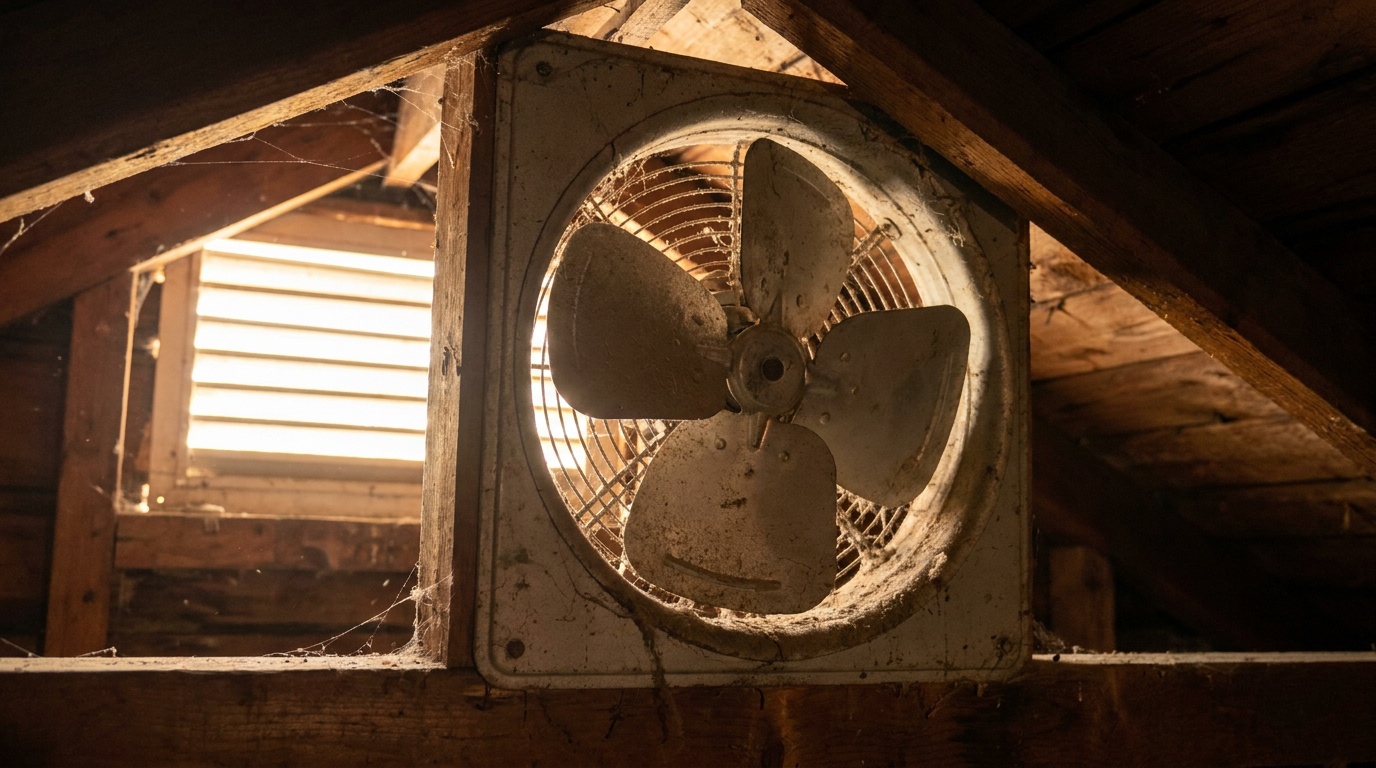
A whole-house fan is installed in your ceiling (typically in a central hallway) and pulls air from open windows throughout the home, pushing hot air into the attic and out through attic vents. The process creates a powerful cross-breeze that can exchange all the air in your home 15 to 60 times per hour, depending on the unit’s capacity.
The critical distinction: a whole-house fan doesn’t cool air. It exchanges air. It replaces the hot, stale indoor air with cooler outdoor air. This means it works brilliantly when outdoor temperatures drop — which in Southern California typically happens after sunset, often between 9 PM and 10 AM the following morning.
Modern whole-house fans in 2026, such as those made by QuietCool and Tamarack Technologies, are dramatically quieter and more efficient than the rattling attic fans of the 1980s. The latest variable-speed models can move 3,000 to 7,000 CFM (cubic feet per minute) while drawing just 100 to 600 watts of electricity. That’s roughly 10 to 90 times less electricity than a central AC system running at full capacity.
Central Air Conditioning: The Precision Cooling Machine
Central AC uses a refrigeration cycle — a compressor, condenser, and evaporator coil — to actively remove heat from your home’s air, regardless of what’s happening outside. You set a thermostat, and the system maintains that temperature around the clock. It also dehumidifies the air as a byproduct, which matters more than most people realize.
A standard 3-ton central AC unit (appropriate for a 1,500–1,800 sq ft home) draws approximately 3,000 to 5,000 watts during operation. In Southern California, where SCE’s tiered electricity rates in 2026 push peak summer rates above $0.52 per kWh in the highest tier, that operational cost adds up with startling speed.
The advantage is absolute reliability. Central AC doesn’t care if it’s 105°F outside at 2 PM. It will cool your home to 72°F regardless. For families with young children, elderly members, or anyone with heat-sensitive medical conditions, that reliability isn’t a luxury — it’s a necessity.
Southern California’s Climate Reality in 2026
Here’s the straight talk: Southern California’s climate has shifted meaningfully over the past decade, and your cooling strategy should reflect 2026 reality, not the assumptions of 20 years ago.
According to the California Department of Water Resources and NOAA’s 2025 Climate Assessment, the Los Angeles Basin now experiences an average of 14 more “extreme heat days” per year (days above 95°F) compared to the 1990s baseline. Inland areas like Riverside, San Bernardino, and the Inland Empire are seeing even more dramatic shifts, with cities like Redlands and Fontana regularly recording temperatures above 105°F during July and August heat waves.
However — and this is crucial — Southern California also benefits from a phenomenon that makes whole-house fans surprisingly viable: the marine layer and coastal cooling effect. Even during brutal heat waves, nighttime temperatures in much of Los Angeles, Orange County, and San Diego typically drop to 65°F to 75°F between midnight and 7 AM. That’s cool enough for a whole-house fan to flush out a day’s worth of accumulated heat and pre-cool your home before the next day’s temperatures climb.
The Climate Zone Divide Within SoCal
Southern California is not climatically uniform. The difference between cooling in Santa Monica versus Riverside is roughly analogous to the difference between coastal Maine and inland Tennessee. Understanding your specific micro-climate is essential.
- Coastal zones (Santa Monica, Long Beach, Carlsbad): Average summer highs of 78–85°F, with nighttime lows regularly hitting 62–68°F. Whole-house fans are exceptionally effective here — arguably superior to central AC for many households.
- Mid-city and valley areas (Pasadena, Burbank, North Hollywood): Summer highs of 92–100°F, but nighttime lows still drop to 68–74°F. A hybrid approach (whole-house fan at night, AC during afternoon peaks) is highly effective.
- Inland Empire (Riverside, San Bernardino, Temecula): Summer highs of 100–112°F, with nighttime lows of 70–78°F. Central AC becomes significantly more important here, though whole-house fans still deliver value during cooler months and evenings.
The True Cost Comparison
Let’s get specific, because vague comparisons don’t pay your electricity bill.
Installation Costs in 2026
A quality whole-house fan — specifically a variable-speed, insulated model like the QuietCool AFG PRO-4.4 or equivalent — runs approximately $900 to $2,200 installed for a typical SoCal home. Premium multi-speed systems for larger homes can reach $3,500. Most homeowners can recoup this investment within 1 to 3 years through energy savings alone.
Central AC installation in Southern California in 2026 is a significantly larger investment: $6,500 to $14,000 for a standard split system, depending on home size, ductwork condition, and whether refrigerant line replacements are needed. Many older SoCal homes built before 1990 require ductwork upgrades that can add another $3,000 to $7,000.
Monthly Operating Costs
This is where the gap becomes striking. Using SCE’s 2026 tiered residential rates and typical SoCal usage patterns:
- Whole-house fan only: Adds approximately $15 to $45 per month to your electricity bill during peak summer months.
- Central AC (moderate use, thermostat set at 76°F): Adds approximately $180 to $380 per month during peak summer in a 1,600 sq ft home.
- Central AC (aggressive use, thermostat set at 72°F): Adds approximately $320 to $480+ per month, especially when factoring in peak-hour pricing.
- Hybrid approach (fan at night, AC 12–4 PM only): Adds approximately $85 to $150 per month — representing roughly a 55–65% reduction compared to AC-only cooling.
Over a 10-year horizon for a mid-valley home in Pasadena, the total operational cost difference between central AC alone and a hybrid whole-house fan + minimal AC strategy can exceed $18,000 to $25,000 — a figure that should get anyone’s attention.
Performance by Region: Which System Wins Where
The honest answer to “which is better” depends on your zip code, home layout, and lifestyle. Here’s a practical regional framework:
Coastal SoCal (below 5 miles from the ocean): A whole-house fan can serve as your primary cooling system for the majority of the year, with central AC as a backup for the roughly 15–25 extreme heat days annually. Many coastal homeowners in 2026 are running their AC fewer than 30 days per year total, using the fan the rest of the time.
Mid-city and valley corridors: The hybrid approach is the strategic sweet spot. Run the whole-house fan from approximately 9 PM to 8 AM to flush out accumulated heat and pre-cool the home’s thermal mass. Use central AC minimally during the peak afternoon hours of true heat waves. This is where you capture most of the savings without sacrificing comfort.
Inland Empire and desert-adjacent communities: Central AC is non-negotiable as a primary system from June through September. However, a whole-house fan still delivers significant value during the spring (March–May) and fall (October–November) shoulder seasons, and during the cooler nights of summer, reducing the total AC runtime by 30–50% annually.
Real Homeowner Case Studies
Case Study 1: The Pasadena Hybrid Convert
Maria and David Chen own a 1,850 sq ft craftsman bungalow in Pasadena. In 2023, their peak summer SCE bills hit $510 in one month, prompting a serious rethink. In early 2025, they installed a QuietCool Stealth Pro 4.8 whole-house fan ($2,100 installed) and changed their cooling strategy.
Their new routine: Open windows each evening around 9 PM, run the whole-house fan until 7 AM, then close the house up. The home’s thick plaster walls and tile floors hold the overnight coolness remarkably well, typically staying below 78°F until 2–3 PM even on 98°F days. They run the central AC only from approximately 2–7 PM on days above 95°F — roughly 30–40 days per summer.
The result? Their peak summer bills in 2025 dropped to an average of $195 per month. Annualized savings: approximately $2,200 per year. Payback period on the fan installation: under 12 months. By 2026, they’ve fully recouped the investment and are pure savings territory.
Case Study 2: The Coastal San Diego Whole-Fan Purist
James Nakamura lives in Carlsbad, 1.8 miles from the coast. His 2,100 sq ft 2001-built home has central AC installed, but he’s run it exactly four times in 2026 through the writing of this article (late July). He installed a two-speed whole-house fan system in 2024 and has not looked back.
In Carlsbad’s mild coastal climate, nighttime lows rarely exceed 70°F even in July and August, and the morning marine layer keeps things manageable until well past noon. James reports his electricity bill averages $145/month year-round — compared to the $290/month average his neighbors without whole-house fans report. The savings are real. The comfort, he says, is also real: “Moving air at 68°F feels cooler than still air at 74°F from the AC. It just feels fresher.”
Case Study 3: The Riverside Realist
Sandra Okonkwo in Riverside tried the whole-house-fan-primary approach in summer 2024. The result was a honest education. During the record July 2024 heat event when Riverside recorded 113°F for three consecutive days and overnight lows stayed at 84°F, her whole-house fan was genuinely useless. Moving 84°F outdoor air into her home at midnight didn’t cool anything. Her central AC ran continuously for 72 hours.
Sandra’s revised 2026 strategy: central AC is her primary system June through September, period. She uses the whole-house fan aggressively from March through May and again in October and November — shoulder seasons when it works brilliantly and cuts her energy bills significantly. “The fan is a great tool,” she says, “but I learned it’s not an Inland Empire summer tool. It’s a spring and fall tool out here.”
3 Common Challenges and How to Overcome Them
Challenge 1: Air Quality and Allergen Concerns
Whole-house fans pull in unfiltered outdoor air. For the roughly 35% of Southern Californians who suffer from seasonal allergies or respiratory sensitivities, this can be a significant problem. The solution isn’t to abandon the whole-house fan — it’s to time its use strategically.
Actionable fix: Check AirNow.gov and the SCAQMD’s daily air quality index before opening your home for ventilation. On days when particulate matter (PM2.5) is in the “Moderate” or above range — particularly common during wildfire season and high-wind Santa Ana events — keep the house closed and run your AC with a high-quality MERV-13 filter instead. Most whole-house fan manufacturers also offer optional filtration attachments, though they do reduce CFM output.
Challenge 2: Noise and Attic Pressure Issues in Older Homes
Many Southern California homes built before 1980 have inadequate attic ventilation for whole-house fan operation. If the attic can’t exhaust air fast enough, pressure builds, reducing fan effectiveness and creating noise. The rule of thumb: your attic needs approximately 1 square foot of free venting area for every 750 CFM of fan capacity.
Actionable fix: Have a contractor assess your attic ventilation before installation. Adding gable vents or upgrading to a powered attic ventilator alongside the whole-house fan is typically a $300–$800 addition that solves the problem entirely and significantly improves performance.
Challenge 3: Santa Ana Wind Events and Whole-House Fan Incompatibility
Santa Ana conditions — hot, dry, easterly winds — represent the single most challenging scenario for whole-house fans. When outdoor temperatures spike to 100°F+ at 10 PM due to Santa Ana winds, running your whole-house fan makes things dramatically worse by pumping superheated desert air indoors.
Actionable fix: This is exactly why the hybrid approach is so valuable. Check forecasts and identify Santa Ana wind advisories from the National Weather Service. On those nights, keep windows closed and run your AC. A smart home thermostat paired with a whole-house fan timer (both available for under $250 combined in 2026) can automate this — the fan turns off automatically if a temperature sensor detects outdoor temps above a set threshold.
Energy Cost Visualization: Monthly Cooling Costs by Strategy
The following chart illustrates estimated average monthly electricity costs added by each cooling strategy for a 1,600 sq ft home in the San Fernando Valley during peak summer months (July–September 2026), based on current SCE tiered rates.
Average Monthly Cooling Cost Added (Peak Summer, SFV)
Source: Estimates based on SCE 2026 tiered rates, ENERGY STAR usage models, and SoCal contractor data.
Head-to-Head Comparison Table
| Metric | Whole-House Fan | Central AC | Hybrid Approach |
|---|---|---|---|
| Installation Cost | $900 – $2,200 | $6,500 – $14,000+ | $7,500 – $16,000 (both systems) |
| Avg. Monthly Peak Cost (SFV) | $20 – $45 | $180 – $400+ | $85 – $160 |
| Effectiveness at 105°F Outdoor Temp | Poor – Counterproductive | Excellent | Excellent (AC takes over) |
| Air Quality / Filtration | None (outdoor air direct) | MERV filtration, dehumidifies | Flexible — AC during poor AQI days |
| 10-Year Total Operating Cost | ~$3,600 – $5,400 | ~$21,600 – $48,000 | ~$10,200 – $19,200 |
Frequently Asked Questions
Can a whole-house fan fully replace central AC in Southern California?
For coastal communities within a few miles of the ocean — think Santa Monica, Hermosa Beach, Encinitas — a whole-house fan can genuinely serve as your primary cooling system for 90% or more of the year. The mild marine climate means extreme heat events are infrequent, and nighttime temperatures are nearly always low enough for effective fan ventilation. For inland communities — Riverside, Rancho Cucamonga, El Cajon — a whole-house fan alone is insufficient during peak summer months. It’s a valuable supplemental tool that significantly reduces AC runtime, but it cannot handle the extreme heat days that are increasingly common inland. The honest answer: it depends entirely on your zip code and lifestyle, but for most of the roughly 65% of the SoCal population living within 15 miles of the coast, a whole-house fan combined with strategic minimal AC use is a genuinely superior approach.
Does running a whole-house fan improve indoor air quality?
The relationship between whole-house fans and air quality is genuinely complex. On the positive side, dramatically increasing air exchange rate flushes out indoor pollutants — VOCs from furniture and cleaning products, cooking odors, accumulated CO2 — that recirculate in a closed AC environment. Multiple studies, including one from Lawrence Berkeley National Laboratory updated in 2024, show that homes using whole-house fans for nighttime ventilation have measurably lower concentrations of indoor air pollutants. The caveat is significant, however: on days when outdoor AQI is elevated due to wildfires, smog, or Santa Ana conditions (increasingly common in Southern California), bringing outdoor air indoors is actively harmful. The practical recommendation is to use the AirNow.gov app or the SCAQMD’s app to check outdoor air quality before running the fan each evening. On poor AQI days — which in SoCal typically number 15–35 per year depending on location — keep windows closed and use filtered central AC instead.
What rebates and incentives are available for whole-house fans in SoCal in 2026?
This is an area where many SoCal homeowners are leaving money on the table. Southern California Edison’s 2026 Energy Efficiency Rebate Program offers rebates of $200 to $400 for qualifying whole-house fan installations, specifically for variable-speed, Energy Star certified models. Southern California Gas Company offers an additional $150 rebate if the fan installation reduces overall HVAC system runtime (documented through a smart thermostat). The federal 25C energy efficiency tax credit, extended through the Inflation Reduction Act and still active in 2026, allows homeowners to claim up to 30% of installation cost for qualifying energy-efficient ventilation equipment, up to a $600 annual credit limit. Combined, a homeowner installing a $2,000 whole-house fan system could receive $750 to $1,000 in total rebates and tax credits — reducing the net cost to $1,000–$1,250 and dramatically shortening the payback period. Contact your SCE representative or visit sce.com/rebates for current program details, as these programs are updated annually.
Your SoCal Cooling Strategy: Making the Smart Move
Here’s the bottom line, stated without ambiguity: for most Southern California homeowners, the binary choice between “whole-house fan vs. central AC” is a false choice. The strategically intelligent approach in 2026 is a tiered, climate-aware hybrid system that leverages each technology for what it does best.
Here’s your practical action roadmap:
- Identify your climate zone honestly. Use the Climate Consultant tool (available free from UCLA’s Department of Architecture) to input your zip code and receive a detailed breakdown of how many cooling hours per year favor natural ventilation versus mechanical cooling. This single step reframes your entire decision.
- If you’re coastal or mid-city, install a whole-house fan first. Don’t wait for a perfect moment. The 2026 cooling season is already underway. A quality installation takes 4–6 hours. Start capturing savings now, and use the money you save to make better decisions about AC down the road.
- If you’re inland and don’t have central AC, get it — but also add the fan. Prioritize AC installation for health and safety reasons during extreme heat events. But plan the whole-house fan as a simultaneous or immediate follow-up investment. The shoulder-season savings alone will justify it.
- Automate the decision-making. A smart thermostat (Ecobee or Nest, both now natively compatible with whole-house fan controls in their 2026 firmware) can monitor indoor and outdoor temperatures and automatically shift between systems. Remove the human friction — the strategy only works if it’s actually followed at 10 PM when you’re tired.
- Track and adjust. Use your utility’s online energy monitoring dashboard (SCE’s “My Account” portal shows daily usage breakdowns) to observe your actual consumption patterns for 60 days after implementing changes. Real data from your real home will tell you exactly how to optimize further.
As California’s grid continues its push toward time-of-use pricing and on-peak rates climb even higher, the economic case for whole-house fans and hybrid cooling strategies will only strengthen. The homeowners who adapt their cooling strategies now — treating energy efficiency as a design challenge rather than a sacrifice — are building genuinely resilient, lower-cost homes for the hotter decades ahead.
The question isn’t really “which system is better?” — it’s “what does your specific home, in your specific Southern California community, actually need to stay cool without financial punishment?” Answer that honestly, and the path forward becomes remarkably clear.
Article reviewed by Pablo Reyes, Wood Flooring Installation & Restoration Expert, on May 4, 2026
