Cool Roof Options: Reflective Solutions for Los Angeles Summer Heat
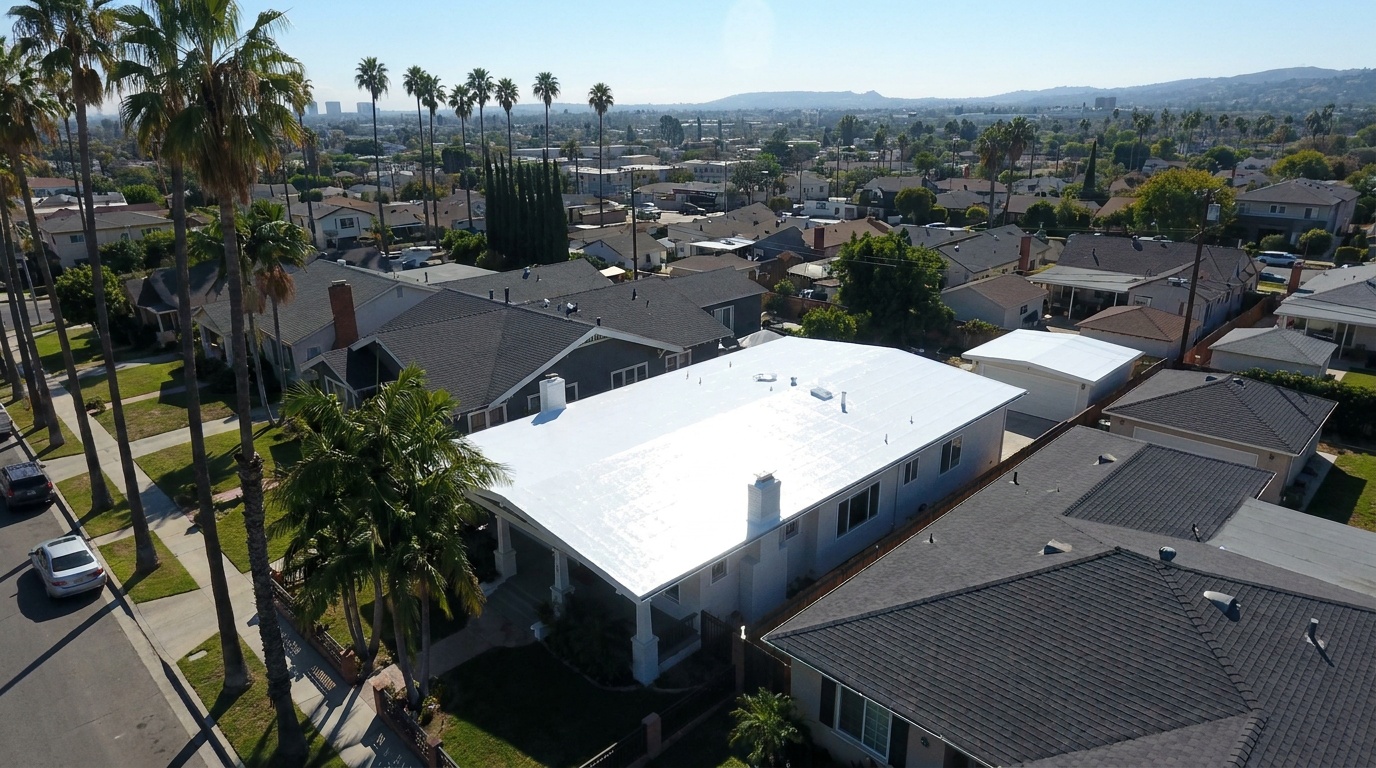
Cool Roof Options: Reflective Solutions for Los Angeles Summer Heat
Reading time: 14 minutes
Another scorching Los Angeles summer. Your air conditioner is running nonstop, your energy bill looks like a mortgage payment, and your rooftop feels like a cast-iron skillet in July. Sound familiar? You’re not alone—and you’re not powerless.
Here’s the straight talk: the biggest untapped energy efficiency opportunity for most LA homeowners and commercial property managers isn’t a solar panel array or a smart thermostat. It’s the roof sitting right above their heads. Cool roofing technology has evolved dramatically, and in 2026, the options available to Angelenos are more effective, more affordable, and more stylish than ever before.
Whether you manage a warehouse in the San Fernando Valley, own a mid-century bungalow in Silver Lake, or operate a retail strip in Culver City, this guide will walk you through every meaningful cool roof option—with real numbers, real case studies, and a clear framework for making the right decision for your specific situation.
Table of Contents
- Why Los Angeles Roofs Are a Heat Problem Worth Solving
- How Cool Roofs Actually Work: The Science Behind the Savings
- Types of Cool Roof Solutions Available in LA
- Side-by-Side Comparison: Cool Roof Options at a Glance
- Real Cost Savings and ROI: What LA Property Owners Are Seeing
- Case Studies: Cool Roof Wins Across Los Angeles
- Common Challenges and How to Overcome Them
- Incentives, Rebates, and LA’s 2026 Regulatory Landscape
- Frequently Asked Questions
- Your Cool Roof Action Plan: Next Steps
Why Los Angeles Roofs Are a Heat Problem Worth Solving
Los Angeles recorded its hottest three-year stretch on record between 2023 and 2025, with summer temperatures in inland neighborhoods like Canoga Park and El Monte regularly breaching 110°F. The urban heat island effect—where dense urban surfaces absorb and re-radiate heat—pushes city temperatures 4 to 7°F higher than surrounding rural areas, according to data from the Los Angeles County Office of Sustainability published in early 2026.
Traditional dark asphalt or gravel roofs absorb up to 90% of incoming solar radiation, converting sunlight into heat that radiates downward into buildings and upward into the urban atmosphere. A low-slope commercial roof on a sunny August afternoon in the San Fernando Valley can reach surface temperatures of 170°F to 190°F—temperatures that degrade roofing materials, spike cooling demand, and make upper floors nearly uninhabitable without aggressive air conditioning.
The ripple effects are substantial:
- Energy costs: LA residential customers averaged $198/month in summer electricity bills in 2025, up 12% from 2023, driven largely by cooling demand (Southern California Edison 2025 Annual Report).
- Public health: Heat-related emergency room visits in LA County exceeded 3,400 during the summer of 2025, disproportionately affecting residents without effective cooling.
- Carbon emissions: Air conditioning accounts for approximately 17% of all residential electricity consumption in LA, representing a significant emissions contributor.
- Infrastructure strain: The strain on the electrical grid during peak summer demand hours has led to targeted rolling outages in three consecutive summers.
The good news? Cool roofing is one of the fastest, most cost-effective interventions available—and LA’s climate, regulatory environment, and contractor ecosystem in 2026 make implementation more accessible than at any previous point.
How Cool Roofs Actually Work: The Science Behind the Savings
To choose the right cool roof solution, you need to understand two key physical properties measured in every certified cool roofing product:
Solar Reflectance (SR) and Thermal Emittance (TE)
Solar Reflectance measures the fraction of incoming solar energy a surface reflects back into the atmosphere, expressed as a value between 0 and 1 (or 0–100%). A conventional dark asphalt roof scores around 0.05 to 0.15 SR—meaning it absorbs 85–95% of sunlight. A certified cool roof coating might score 0.70 to 0.90 SR, reflecting 70–90% of that energy away before it becomes heat.
Thermal Emittance measures how efficiently a surface radiates absorbed heat back out as infrared energy. High emittance (close to 1.0) means the roof quickly releases whatever heat it does absorb rather than storing it and conducting it into the building below.
The combination of these two properties produces the Solar Reflectance Index (SRI), the single number most commonly used to rate cool roof performance. The Cool Roof Rating Council (CRRC), which maintains the industry’s product database, requires a minimum SRI of 82 for low-slope roofs and 29 for steep-slope roofs to qualify for ENERGY STAR certification as of 2026 standards.
The Urban Heat Island Feedback Loop—and How Cool Roofs Break It
Here’s why cool roofs matter at the city scale, not just the building scale. When thousands of rooftops in a dense urban area simultaneously radiate absorbed heat back into the atmosphere, they create a feedback loop: hotter ambient air increases cooling demand, which increases electricity consumption, which increases power plant output, which releases more heat and emissions, which warms the air further.
A landmark modeling study published by Lawrence Berkeley National Laboratory estimated that if Los Angeles converted just 50% of its rooftop area to cool roofing, the citywide ambient temperature could drop by 1.5 to 2°F during peak summer afternoons. That’s enough to meaningfully reduce grid demand, lower heat-related health risks, and cut municipal cooling costs in public buildings by an estimated $15 million annually.
In 2026, the LA City Council’s Green New Deal implementation framework includes cool roofs as a core strategy—giving the technology institutional tailwind it hasn’t always had.
Types of Cool Roof Solutions Available in LA
Not all cool roofs are created equal, and the right solution depends heavily on your roof type, budget, aesthetic priorities, and performance goals. Here’s a practical breakdown of every major category:
Reflective Roof Coatings: The Fastest and Most Affordable Entry Point
Reflective coatings are liquid-applied products—typically elastomeric acrylics, silicones, or polyurethanes—that are rolled or sprayed directly onto an existing roof surface. They bond to the substrate, creating a seamless, waterproof membrane with high solar reflectance.
Best suited for: Flat or low-slope roofs (commercial buildings, apartment complexes, warehouses). Can also be applied to metal roofs.
Performance range: SR of 0.70–0.88, TE of 0.85–0.92. Quality products like Gaco Western’s GacoFlex or Tremco’s AlphaGuard achieve SRI values of 104–110 when freshly applied.
Cost in LA (2026): $1.50 to $3.50 per square foot installed, depending on substrate preparation, product grade, and roof complexity.
Lifespan: 10–20 years with proper maintenance; many manufacturers offer 20-year performance warranties on premium silicone systems.
Key advantage: You don’t need to tear off your existing roof. If the substrate is structurally sound, a coating can be applied over it, dramatically reducing installation cost and landfill waste.
Practical tip: Always have the existing membrane professionally inspected before coating. Applying a reflective coating over a roof with active moisture intrusion or delamination is a common mistake that voids warranties and leads to premature failure.
Cool Roof Membranes: TPO and PVC for High-Performance Low-Slope Applications
Thermoplastic polyolefin (TPO) and polyvinyl chloride (PVC) single-ply membranes are the workhorses of commercial cool roofing in Los Angeles. Both materials are manufactured in white or light-colored formulations with excellent inherent solar reflectance.
TPO highlights: SR of 0.79–0.85, TE of 0.90–0.93. Less expensive than PVC, widely available, and highly resistant to UV degradation and puncture. Major manufacturers include Carlisle SynTec, GAF, and Firestone.
PVC highlights: SR of 0.82–0.89, TE of 0.90–0.93. Superior chemical resistance and weld strength compared to TPO. Premium pricing reflects these performance advantages. Ideal for restaurants, chemical manufacturing, or any application where roof-top grease or chemical exposure is a concern.
Cost in LA (2026): $5.50 to $10.00 per square foot installed for both systems, depending on insulation thickness and attachment method.
Lifespan: 20–30 years for quality installations.
Cool Roof Tiles and Shingles: Aesthetic Solutions for Residential LA
For the millions of LA homeowners with pitched roofs—Spanish tile Craftsmans in Pasadena, stucco ranch homes in the Valley, hillside contemporary builds in the Hollywood Hills—cool roofing has historically felt like a trade-off between performance and curb appeal. That’s no longer true.
Cool-rated clay and concrete tiles: Many traditional terracotta and concrete tile profiles now come in formulations with CRRC-certified solar reflectance. Light-colored tiles naturally achieve SR of 0.40–0.60, while specially treated tiles with pigmented coatings reach 0.50–0.75. The added benefit of tile’s natural air gap above the roof deck provides additional thermal insulation.
Cool asphalt shingles: Major manufacturers including Owens Corning, GAF, and CertainTeed now offer ENERGY STAR-certified shingles using “cool pigment” technology—special infrared-reflective granules that reflect the non-visible portion of the solar spectrum even in darker colors. A “Charcoal” cool shingle might achieve SR of 0.29–0.35 versus 0.08–0.12 for a conventional dark shingle. That’s a meaningful improvement without sacrificing the classic look many homeowners prefer.
Cool metal roofing: Standing seam and metal shingle products in reflective finishes (usually PVDF-coated) offer SR of 0.55–0.70 with excellent emittance. These are increasingly popular in contemporary residential new construction in LA’s Westside and South Bay communities.
Green Roofs and Hybrid Systems: The Premium Urban Solution
Green roofs—vegetated systems incorporating growing media, drainage layers, and plants—function through a fundamentally different cooling mechanism: evapotranspiration. Rather than reflecting heat, they use it to evaporate water, cooling both the roof surface and the surrounding air.
In LA’s Mediterranean climate, green roofs require careful plant selection (drought-tolerant sedums, native succulents) and supplemental irrigation planning. They’re more complex and expensive ($15–$30+ per square foot installed) but deliver multiple co-benefits: stormwater management, habitat creation, and visual amenity value that can support property value premiums.
Hybrid cool roof + green roof systems—a white membrane base layer with modular green roof trays—are increasingly being specified on commercial and multifamily projects in LA, combining the high SR of the membrane in uncovered zones with the evaporative cooling of the vegetated areas.
Side-by-Side Comparison: Cool Roof Options at a Glance
| Solution Type | Typical SRI Range | Installed Cost ($/sq ft) | Best Application | Estimated Lifespan |
|---|---|---|---|---|
| Reflective Coatings | 90–110 | $1.50–$3.50 | Flat/low-slope commercial | 10–20 years |
| TPO/PVC Membrane | 85–105 | $5.50–$10.00 | Commercial/multifamily flat roofs | 20–30 years |
| Cool Clay/Concrete Tile | 30–75 | $8.00–$16.00 | Residential pitched roofs | 40–50+ years |
| Cool Asphalt Shingles | 25–45 | $4.00–$8.00 | Residential pitched roofs | 25–30 years |
| Green / Hybrid Roof | Varies (cooling via ET) | $15.00–$30.00+ | Urban commercial, multifamily | 30–50 years |
Real Cost Savings and ROI: What LA Property Owners Are Seeing
Let’s get concrete about the financial case—because while environmental benefits are real, most property owners need to see a return on investment to justify the capital expenditure.
The US Department of Energy’s Oak Ridge National Laboratory modeling, updated in 2025, estimates that a high-performance cool roof coating on a typical LA commercial flat roof can reduce rooftop cooling load by 10–30%, translating to annual electricity savings of $0.15 to $0.40 per square foot depending on building type, insulation levels, and occupancy.
For a 20,000 square foot commercial roof in the San Fernando Valley, that’s $3,000 to $8,000 in annual savings. At a coating cost of $40,000–$70,000 installed, simple payback periods of 5–12 years are achievable—with the roof continuing to perform for another 10–15 years after payback, delivering pure savings.
For residential homeowners, the picture is more modest but still meaningful. A study tracking 85 Southern California single-family homes with ENERGY STAR cool roofs (published in the Journal of Building Performance, 2024) found average summer cooling bill reductions of $185 to $320 per cooling season, with homes featuring older, less efficient HVAC systems showing the strongest savings.
Quick Scenario: Imagine you’re a property manager for a 50-unit apartment complex in North Hollywood with a conventional black membrane roof installed in 2014. That roof is approaching end of life. Rather than replacing it like-for-like with another dark membrane, you upgrade to a white TPO system. Your tenants complain less about heat on the top floor. Your building’s common-area cooling bill drops by 18%. The upgrade qualifies for a $15,000 rebate through the LADWP Cool Roof Incentive Program. Your effective payback period shortens from 11 years to 7.5 years. That’s strategic facility management.
Energy Savings Potential by Roof Type: LA Comparison
Estimated Annual Cooling Load Reduction (%)
Source: Compiled estimates from LBNL, DOE Oak Ridge National Laboratory, and CRRC field data (2025–2026). Values represent typical performance ranges for LA climate zone; actual savings vary by building type and insulation.
Case Studies: Cool Roof Wins Across Los Angeles
Case Study 1: The Warehouse District Turnaround — Vernon, CA
A 120,000 square foot food distribution warehouse in Vernon, operating around the clock with significant internal heat loads from refrigeration and logistics equipment, had been battling runaway summer energy costs since 2019. Its original built-up asphalt roof, nearly 22 years old by 2025, had an SR of approximately 0.08.
In early 2025, facility managers partnered with a Los Angeles-based commercial roofing contractor to install a two-coat silicone cool roof coating system over the existing substrate after targeted repairs to blistered and delaminated sections. The specified product achieved an SRI of 107 when tested.
Results after one full cooling season (summer 2025):
- Peak rooftop surface temperature dropped from an average of 178°F to 94°F on comparable high-radiation days.
- Cooling-related electricity costs for the facility fell by 22%, saving approximately $61,000 in the first year.
- LADWP Cool Roof rebate of $18,000 (at $0.15/sq ft) effectively reduced net installation cost from $312,000 to $294,000.
- Simple payback: approximately 4.8 years.
The facility manager noted a secondary benefit nobody had anticipated: reduced thermal cycling on the roof membrane meant fewer expansion-contraction stress events, and maintenance calls for minor leak repairs dropped by roughly 60% compared to the prior two summers.
Case Study 2: Residential Cool Tile Retrofit — Glendale, CA
Maria and David Sandoval, owners of a 2,200 square foot Spanish-revival home in Glendale, faced a roof replacement in 2025 when their original concrete tile system reached the end of its serviceable life. Concerned about both rising summer utility bills and maintaining their home’s historic aesthetic, they worked with a roofing consultant to explore cool tile options.
They selected a CRRC-certified cool-pigment concrete tile in a traditional “Barrel” profile and terracotta colorway from Marley Eternit, achieving an SR of 0.48 versus 0.16 for their original tile. Combined with a radiant barrier deck installed during the re-roof, total thermal performance improvement was substantial.
Outcomes:
- First summer (2025) cooling bills averaged $143/month versus $221/month the prior year—a 35% reduction.
- Upstairs bedrooms, previously uncomfortably warm even with AC running, maintained comfortable temperatures without the AC reaching maximum output.
- A $1,500 rebate from Southern California Edison’s Residential Roofing program partially offset the $19,500 re-roof cost.
“We didn’t want something that looked like a science experiment on our roof,” Maria said. “The new tiles look identical to what we had before—but our house is actually livable in August now.”
Common Challenges and How to Overcome Them
Challenge 1: “My Roof Isn’t Ready for a Coating”
One of the most common frustrations cool roof project managers encounter is discovering mid-project that the existing roof membrane has too much moisture damage, delamination, or structural deterioration for a coating to be applied over it. Applying a cool coating over a compromised substrate is like painting over a rotten wall—it looks fine briefly, then fails catastrophically.
Solution: Always commission an infrared (IR) thermography scan of the existing roof before specifying a coating. IR scans detect trapped moisture within the roof assembly that isn’t visible to the naked eye. In Los Angeles, experienced commercial roofing contractors can perform IR scans for $0.02 to $0.05 per square foot—a modest investment that prevents expensive post-installation failures. If moisture is widespread (more than 25% of the roof area), a tear-off and replacement with a new cool membrane is typically more economical long-term than trying to coat over compromised material.
Challenge 2: HOA Restrictions and Aesthetic Concerns
In Los Angeles’s many deed-restricted communities, homeowners associations sometimes prohibit highly reflective or non-traditional roofing materials—particularly in historic neighborhoods like Hancock Park or in gated communities with strict architectural standards. This is a real barrier for homeowners who want to adopt cool roofing but fear HOA fines or denial of approval.
Solution: California Civil Code Section 714.1, last strengthened in legislation signed in 2022, prohibits HOAs from unreasonably restricting the installation of solar energy systems and energy-efficient roofing. While HOAs retain some aesthetic control rights, they cannot outright prohibit ENERGY STAR-certified cool roofing materials. Present your HOA board with the specific product specifications, its SRI rating, and California’s legal framework. In practice, the expanded range of cool shingles and tiles available in 2026—many visually indistinguishable from conventional materials—makes aesthetic objections increasingly moot.
Challenge 3: Performance Degradation Over Time
Cool roof coatings and white membranes can experience soiling degradation—the accumulation of dirt, biological growth (algae, mold), and atmospheric particulates that reduce solar reflectance over time. A freshly installed coating with SR of 0.85 might drop to SR 0.65 after three to five years in LA’s smoggy urban environment, meaningfully reducing cooling performance.
Solution: Annual or biannual roof cleaning—simply washing the surface with low-pressure water and a mild detergent—restores approximately 80–90% of original reflectance. Many roofing contractors offer maintenance contracts for $0.03–$0.06 per square foot annually. Additionally, specifying products with antimicrobial additives (which inhibit algae and mold growth) at the time of installation significantly slows the soiling rate. Some premium silicone coating formulations now incorporate self-cleaning hydrophilic surface chemistry that causes rainwater to sheet off and carry surface contaminants with it.
Incentives, Rebates, and LA’s 2026 Regulatory Landscape
Los Angeles has built one of the more supportive policy environments for cool roofing of any major US city. Understanding available incentives can meaningfully improve project economics:
LADWP Cool Roof Incentive Program (2026): Provides $0.10–$0.20 per square foot for qualifying cool roof installations on commercial and multifamily buildings, with higher rates for buildings in designated Heat Vulnerable Zones (primarily South and Southeast LA, and parts of the San Fernando Valley). Applications for 2026 funding cycles are processed on a first-come, first-served basis through the LADWP Business Programs portal.
Southern California Edison (SCE) Cool Roof Rebates: SCE’s 2026 commercial rebate program offers $0.05–$0.10 per square foot for cool roofs meeting minimum CRRC ratings, combined with their energy audit program that can surface additional HVAC optimization incentives. Residential rebates of $500–$1,500 are available for ENERGY STAR-certified roof products.
California Title 24 Building Energy Standards: The 2025 update to California’s Title 24 code, effective January 2026, expanded mandatory cool roof requirements for low-slope roofs in California’s Climate Zone 9 (covering most of LA County) to include buildings undergoing major renovations, not just new construction. If you’re planning a significant building renovation in 2026, verify whether your project triggers Title 24 cool roof compliance—in most cases, this requirement aligns naturally with best-practice choices.
Federal Tax Deductions: Commercial building owners can potentially deduct cool roof costs under Section 179D of the IRS tax code if the installation contributes to meeting energy reduction thresholds. Consult a tax professional familiar with commercial real estate for current applicability.
Pro Tip: Stack your incentives wherever possible. A commercial building owner in LADWP territory who qualifies for LADWP rebates, SCE energy audit incentives, and Section 179D deductions could effectively reduce their net cool roof cost by 25–40%—dramatically improving payback periods.
Frequently Asked Questions
Will a cool roof make my building too cold in winter?
This is the most common concern homeowners raise, and the evidence consistently shows it’s a minor factor in LA’s climate. Yes, a cool roof reflects some solar heat gain that would otherwise help warm your building on cool winter days. However, Los Angeles’s mild winters—average highs of 65–70°F in December and January—mean heating loads are relatively small to begin with. Studies of Southern California homes with cool roofs consistently find that any small increase in winter heating costs is far outweighed by summer cooling savings, typically by a ratio of 5:1 or greater. If your property has excellent attic insulation (R-38 or higher), the heating impact is further minimized.
How do I verify a contractor is installing a legitimate cool roof product?
This is essential due diligence—greenwashing exists in the roofing industry. Always request the specific CRRC product ID for the material your contractor proposes to install, then verify it independently at coolroofs.org, the CRRC’s public product database. Confirm the listed rated values (SR and TE) match what your contractor is promising. For ENERGY STAR eligibility, check the ENERGY STAR Roof Products Finder at energystar.gov. Legitimate cool roof products will have current third-party ratings; if a contractor can’t provide a CRRC product ID, treat that as a red flag. Also verify that your contractor holds a current California State Contractors License Board (CSLB) license—Class C-39 for roofing—and request references from cool roof projects they’ve completed in LA within the past two years.
Can I install a cool roof coating myself to save money?
DIY cool roof coating is technically possible for smaller residential flat roofs (garage roofs, accessory structures) and some low-slope home roofs accessible with basic safety equipment. Retail-grade elastomeric roof coatings—products like Gardner-Gibson’s White Knight or Henry’s Tropi-Cool—are available at home improvement stores for $0.50–$1.00 per square foot in materials, though performance ratings are generally lower than commercial-grade products. However, for your primary residence roof or any commercial property, professional installation is strongly recommended. The substrate preparation—cleaning, priming, crack filling, and detail work around penetrations—accounts for 60–70% of a coating’s long-term performance, and skipping or under-executing these steps leads to early failure, potentially voiding any manufacturer warranty. Professional installation also typically qualifies for utility rebates, while DIY applications often do not.
Your Cool Roof Action Plan: Next Steps
You’ve absorbed the science, the economics, the product landscape, and the LA-specific context. Now let’s turn that knowledge into momentum. Here’s your practical roadmap:
- Assess your roof’s current condition and type. Before any other step, get a professional roof inspection—ideally including an IR thermography scan if you have a flat or low-slope commercial roof. Understanding what you’re starting with determines what options are viable. Budget $200–$600 for a quality inspection on a residential roof; $0.03–$0.05/sq ft for IR scanning on commercial roofs.
- Match the solution to your roof geometry and timeline. Flat/low-slope commercial or multifamily? Start getting specifications for TPO membrane replacement or silicone coating, depending on current roof condition and age. Residential pitched roof due for replacement? Request quotes specifically comparing your current material like-for-like versus an ENERGY STAR-certified cool alternative. The price difference is often smaller than homeowners expect.
- Identify and apply for available incentives before signing a contract. Contact LADWP (if you’re in their service territory) and SCE to confirm current rebate availability and documentation requirements. Some rebate programs require pre-approval before installation. Don’t leave money on the table by applying after the fact.
- Request CRRC-verified product specifications from at least three contractors. Competitive bidding matters, but so does product quality. Require all bidders to quote products with documented CRRC ratings, and compare both product performance and contractor credentials. The cheapest quote with an unverified product is rarely the best value.
- Build in a maintenance plan from day one. Ask your contractor about maintenance agreements and schedule annual cleaning from the beginning. Cool roofs that are cleaned regularly maintain performance levels 30–40% higher than neglected systems over a 10-year period—that difference compounds significantly over the roof’s lifespan.
Cool roofing isn’t just a building upgrade—it’s an investment in the liveability of Los Angeles itself. Every reflective roof surface added to the city’s thermal landscape contributes to breaking the urban heat island cycle that drives so much of the region’s summer suffering and energy strain. The technology is proven, the economics are compelling, and the support infrastructure—from rebate programs to a mature contractor ecosystem—has never been better than it is in 2026.
The question worth sitting with: If a single decision could meaningfully lower your energy bills, extend your roof’s lifespan, improve your building’s comfort, and make a tangible contribution to cooling an overheating city—what’s actually stopping you from making that decision this season?
Article reviewed by Pablo Reyes, Wood Flooring Installation & Restoration Expert, on May 4, 2026
